All posts by Small Tokyo Kitchen

A Japanese Tokyoite loving food, design, culture and writing

chicken marbella

wow i just realised that my category list on the right is getting longer – i categorise my blog using the names of the countries where my recipes are inspired from, with a few exceptions such as ‘essay’ and ‘poem.’ this time, another country has been added – it is the first spanish dish that i have learned to cook, which is called ‘chicken marbella.’
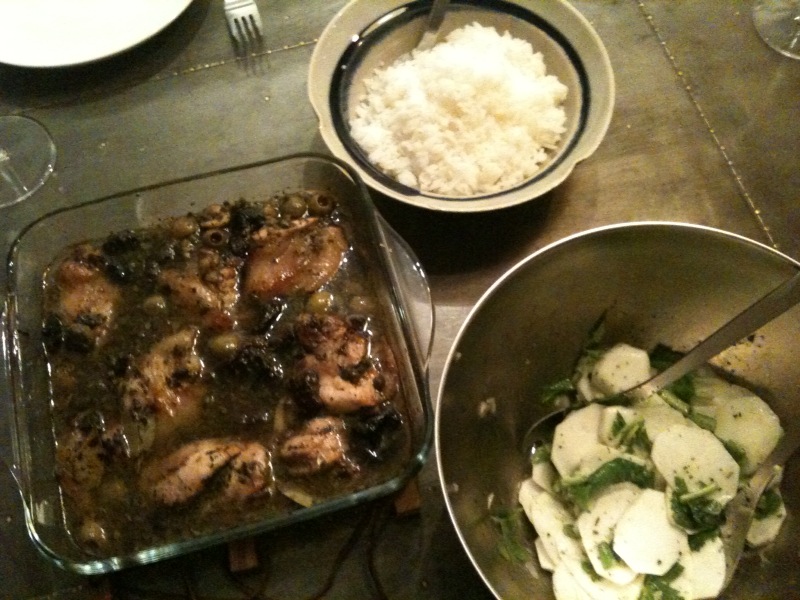

chicken marbella dinner along with turnip salad

it is an oven dish, and it may be meant for cold weather. on the contrary however, for the past few weeks it has been boiling hot in tokyo, now that the rainy season is over. to make the matter worse, we have been trying to save energy all over japan due to the nuclear power plant failure in fukushima back in march. this means we try not to use an air conditioning during the day as much as possible and instead use only a small electric fan (uses much less electricity). in such heat i usually loose my appetite, but somehow, the other day, i craved for the taste of chicken marbella. maybe the bright sunshine may have reminded me of spain, which may have reminded me of juicy green olives, which reminded me of chicken marbella.

what is so special about chicken marbella is its marinade. it is made with olive oil, red wine vinegar, garlic, oregano, prunes, green olives and capers. after marinating chicken overnight in this marinade, it magically transforms the plain chicken to something truly delicious and memorable, offering an amazing kick & depth in taste and richness & moisture in texture.

and another nice thing about chicken marbella is that it is super easy to prepare – mix the marinade, marinate the chicken overnight, and put it into the oven for 40 – 50 minutes the next day – boom! it looks so dazzling and splendor, perfect for a dinner party.
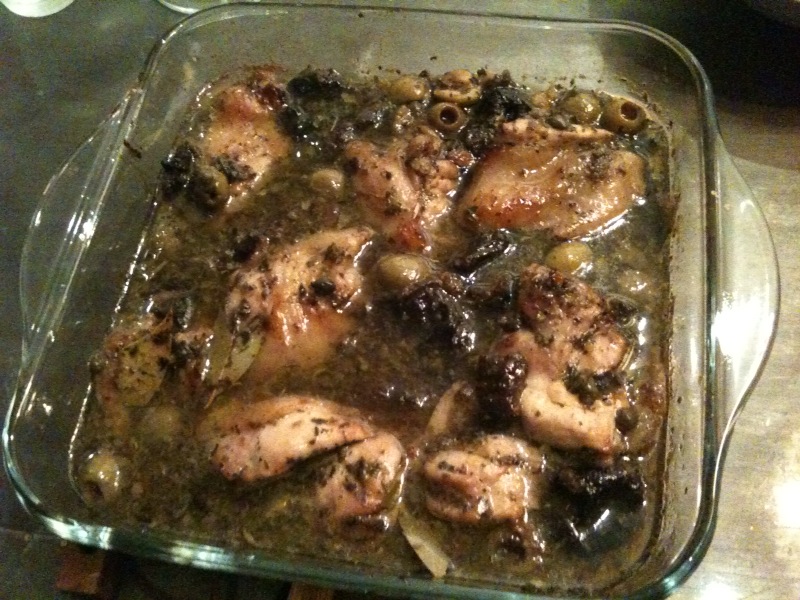
here is the recipe:

chicken marbella (serves 2 – 3)

500g of chicken thigh, cut into quarters and seasoned with sea salt & freshly ground pepper

marinade:

a little more than 1/4 cup of red wine vinegar
a little more than 1/4 cup of extra virgin olive oil
a little more than 1 tbs of dried oregano
1 – 2 cloves of garlic, grated
1/2 cup of pitted prunes
1/2 cup of pitted green olives
1/4 cup of capers (with juice)
a few bay leaves
salt & pepper

– in a large bowl, lay the chicken pieces and mix in the marinade
– put a plastic wrap over the bowl and let it rest in the fridge overnight

– next day, preheat the oven to 180 degrees C
– lay the chicken pieces in a baking pan, pour over the marinade over them
– prepare the following ingredients:

a little more than 1/4 cup of white wine
a little more than 1/4 cup of red sugar

– pour the above ingredients over the chicken prior to putting the pan in the oven
– when it is ready, put the pan in the oven and cook it for 40 – 50 minutes or so until the chicken is fully cooked
– serve chicken marbella with rice (i recommend jasmine rice)
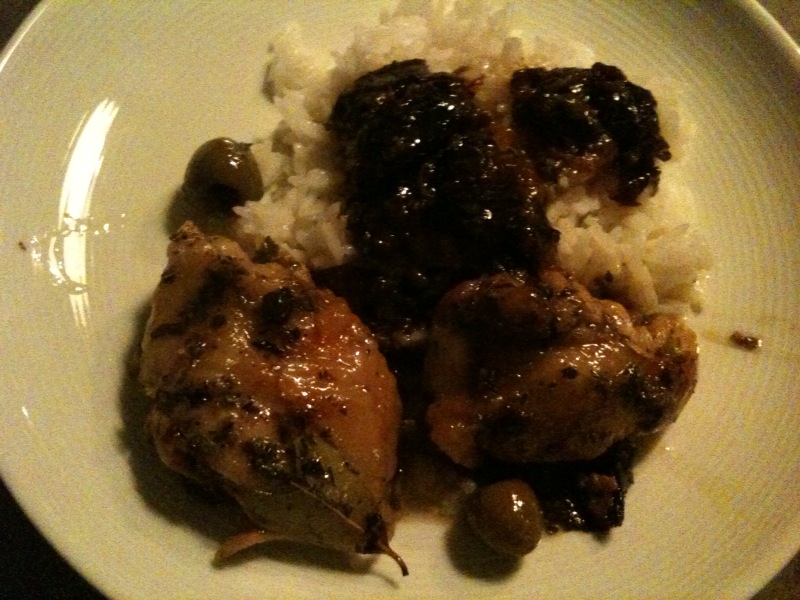

on a plate

its taste gets even better the following day – the marbella sauce gets a bit thicker and tastier. make sure to have some leftovers so that you can enjoy it once again!
poem – written on 1/jan/09

”幸せにする自信がない”
そう言って
去って行った人
何度も、長い間、
どこがいけなかったのかと
自分を責めた
……………..

ある日、ある時、
”幸せにしたいんだ”
そんな人に
出会った

2009年1月1日

(translation)

he left saying
”not sure if i can make you happy”

many times, for a long time,
i blamed myself
wondering what i had done wrong

……………..

one day, one time,
met a man
who said

“i want to make you happy”

1/1/2009

poem – reconciliation

stunned
with your unexpected words
flown from your heart
not sure why
you told me so

captured
with your sincere gaze
flown out of your heart
not sure why
you did it so

time
gave us a perspective
that now
we can be friends

embrace
we go separate ways
feeling the warmth
flown into our hearts

chicken couscous – a touch of african flavour

in tokyo, there is this lovely petite restaurant called “aila” where they serve “french colonial” style cuisine. their dishes are based on the french food with a bit of north african tastes. there are dishes like tagine, moroccan lamb confit and fish cous cous.

i’m not very sure if the expression “french colonial” is politically correct, but it appears to be socially accepted over here, or perhaps people just don’t question it. since japan is a monocultural society where people are quite innocent and not very sensitive about issues involving diverse cultures, we sometimes get stunned at what we witness in our everyday life here in tokyo, just like this example. if some western people see it (including my husband), they would either roll their eyes or shrug their shoulders and move on, because they know that we mean it well.

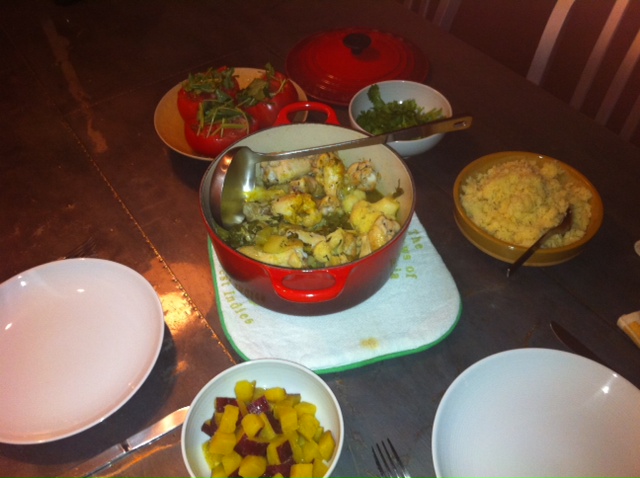
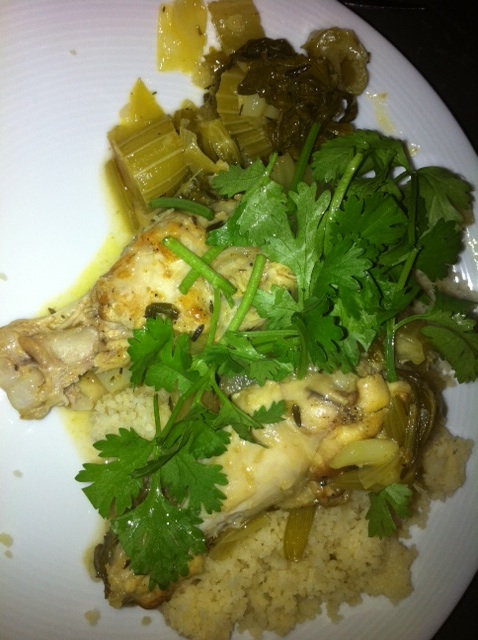
well getting back to the food topic – this dish, “chicken couscous,” is my own invention which is inspired by a dish i once had at aila. i can’t remember the exact flavour and spices they used, but i made it close enough to get the north african touch to the dish.

here is the recipe:

chicken couscous stew

12 chicken drumsticks
2 cloves of garlic
2 bunch of celery (with leaves)
1 japanese leek (even better if it is normal leek)
1/2 bunch of cauliflower
3-4 table spoons of extra virgin olive oil
1 table spoon of dried thyme
1/2 cup of white wine (or more if you like)
1/2 cup of water
2 table spoons of colombo powder (or garam masara powder)
salt & pepper to taste

1. season the drumsticks with salt & pepper
2. cut the celery stems into 2cm length. we’ll use leaves too
3. cut the leek into 2cm length
4. roughly dice the garlic
5. in a stew pan (i use le creuset), pour the oil and gently fry the garlic in low heat
6. add the celery and the leek and stir-fry them further in low heat, for another 15 minutes or so
7. in a separate frying pan, pour some more oil (additional) and fry the drumsticks until their surface get golden
8. pour in the white wine into the drumsticks, put the lid on, lower the heat and cook it for 1 minute or so
9. add the drumsticks with all the juice coming out of the chicken in the stew pan (and do not wash the frying pan, because we will use it to cook couscous later on)
10. add the celery leaves, the thyme and the colombo (curry) powder, and half a cup of water into the stew pan, put the lid on and simmer for 10 minutes or so
11. in a separate small pan, bring water to boil and boil cauliflower for 3 minutes or so
12. add the cauliflower to the stew pan, and let it simmer for another 5 – 10 minutes
13. add salt & pepper to taste

for couscous:

1 cup of cous cous
1 cup of water

1. in the frying pan we used earlier, add a cup of water and bring it to boil. when it’s boiled
2. add the couscous and turn off the heat. mix them well, put the lid on and steam it for 1 minute.

on the side, i served diced sweet potatoes (simmer them with a little bit water, a tea spoonful of honey and a tea spoonful of olive oil). somehow the sweet potatoes go along very well with this chicken dish.

escape

for the past weekend, due to my husband’s work, i had a chance to go along with him to shimoda, the southernmost point of izu peninsula in shizuoka prefecture, south west of tokyo. his (and his partner’s) architectural office has been commissioned to work on a resort development project down there by the shore. after a 3-hour train ride from tokyo main terminal, we arrived in the small town of shimoda, where all the chaos we encounter in our everyday urban life seems to be nonexistent.

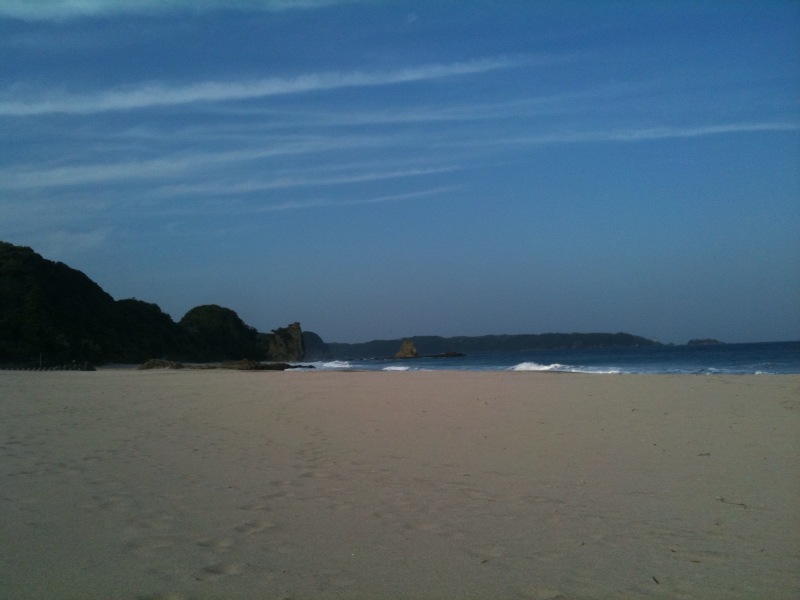
while they went for a walk-through on the site with the client, i went alone to an almost deserted beach nearby. at the off-season beach, there was hardly anyone except for a few surfers, despite the lovely weather with amazing sunshine and gentle sea breeze. it was literally a paradise and a perfect get-away to me.

sitting alone on the white sand, looking at the waves, feeling the breeze softly touching my cheeks and hearing the sound of ripple in the back of my head, i started remembering how much i had craved for being where i was that day.

i grew up in a small inland city of japan where the city/prefecture boarder did not touch any ocean. the city is surrounded by the mountains, which creates a quite protective mentality in its inhabitants. naturally people are very conservative, and they don’t seem to know that you can have different views. mostly because of it, i always felt captured and oppressed, wanting so much to escape to somewhere out there, with more potential in life, with more exposure to the outside world. in some place yet to be seen, i used to think, there must be a perfect location where i completely fit in. by being close to the sea or a river or a metropolitan city, i believed that i could get out anytime, to anywhere i wanted to go. by the time i hit my adolescent period, the feeling got stronger and i often dreamed of putting myself to a bigger scale of the world, hoping that such place would exist, where i would feel fully satisfied at last.

with a twist of fate i left my suburban city shortly after that, and from then on i moved around the world. in america i lived by the atlantic ocean, and in australia i lived next to the tasman sea. in the u.k. i lived in london which is considered to be one of the biggest cities in the whole world. in italy i was in milan, where i had an easy access to travel freely to anywhere in europe. in theory i had a perfect environment, but i am not sure if i can truly admit that i was entirely happy and that my life turned out to be the one i had always wanted. because wherever i went, wherever i traveled, i always, without any failure, started missing my family and longed for intimacy. what i had thought was an escape became a torture, and every time that happened i resigned to my emotional craving and came back to my comfort zone.

my mind drifted back to the deserted beach when i heard my husband’s footsteps, and i realised what a pleasure it could be to have a place to escape, when you knew for sure that there was a place you could go back to, to something real and truly genuine. after all it is not a physical location which makes you feel fulfilled. i can say it now that it is more of an emotional well-being which dictates the level of your fulfillment.

a vast landscape of the ocean extends in front of me, but i don’t have any desire to escape now – i love my life now, and i know it for sure.

fried rice with salmon 鮭チャーハン

in the japanese kitchen, there are many dishes which are influenced by cuisines from other countries. curry & rice, one of the earlier japanese dishes i posted for example, is influenced by (obviously) the indian.

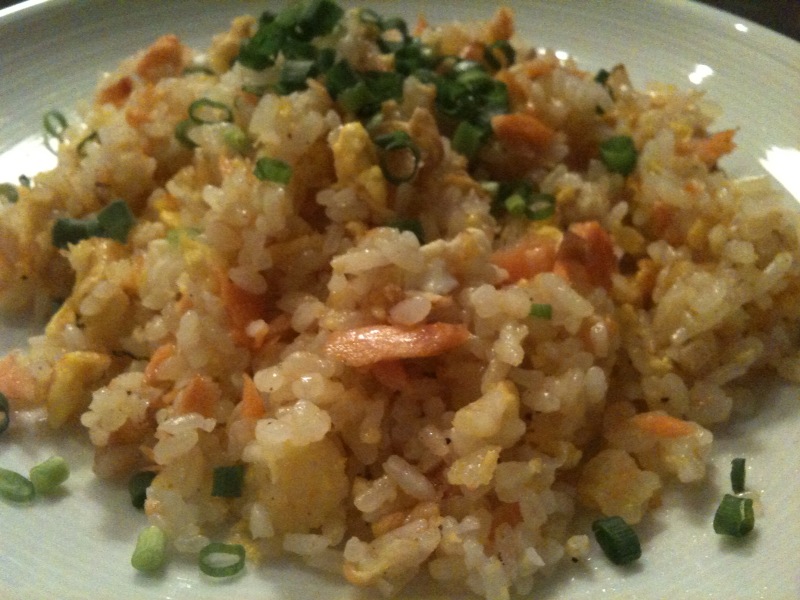
last night, i made 鮭チャーハン “sake cha-han“, fried rice with salmon. in japan, we eat many kinds of fried rice dishes, which are variations from the chinese kitchen. with our impeccable talent to recreate and enhance, a series of modern japanese dishes with foreign origins were born, just like this salmon cha-han:

fried rice with salmon

– 1 fillet of salmon (lightly salted, grilled and broken into rough pieces before frying)
– 2 eggs, beaten
– 2+ cups of cooked rice
– 12cm of japanese leek, chopped
– 4 table spoons of salad oil
– 1+ table spoon of japanese sake
– salt & pepper to taste
– if available, a pinch of konbu (kelp) dashi powder, but can do without
– sprinkle of chopped spring onion or chives

1. in a frying pan or a wak, pour in the oil and heat it up well (really well), and add the eggs
2. quickly scramble the eggs with a spatula and when they are still half cooked, add the rice and quickly mix it with the eggs
3. once mixed, add the leek and the salmon and further stir-fry quickly
4. from the rim of the pan, add the sake (the alcohol will remove the fishy smell of the salmon) and the konbu powder (if available) and further stir-fry quickly
5. at the end, add salt & pepper to taste and quickly stir-fry
6. when serving, sprinkle the spring onion/chives over the fried rice.

the entire steps from 1 – 5 only takes about 5 minutes or so (or even less). do every step very quickly, in order to avoid the rice from getting soggy and sticky.

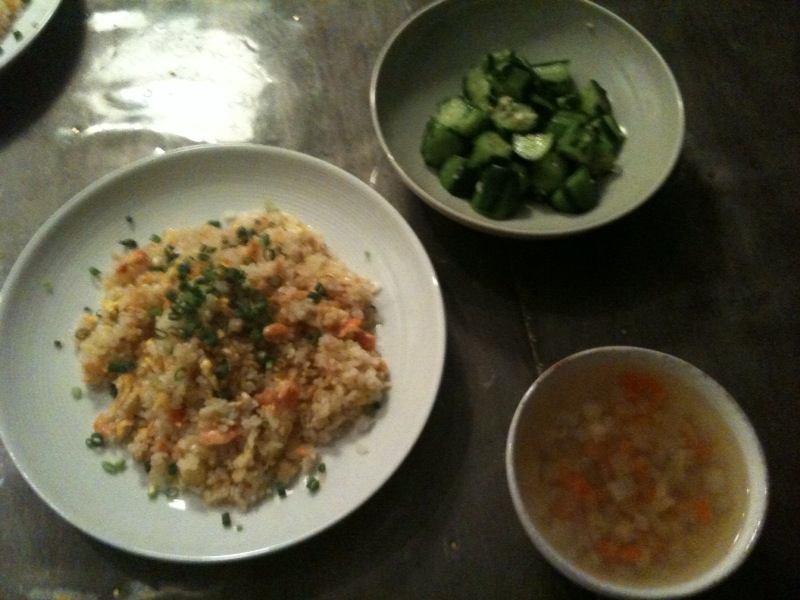
this time, i served the fried rice with vegetable soup (in chicken broth) and cucumber salad.

召し上がれ meshiagare (bon appetite)!

my soul food 故郷の味 (& recipe for spinach goma-ae)

our dinner last night – a few, very typical, japanese dishes:

– アジの干物 “aji no himono“, grilled horse mackerel (seasoned & dried)
– かぼちゃと鶏挽肉の煮物 “kabocha to tori-hikiniku no nimono“, simmered pumpkin and minsed chicken
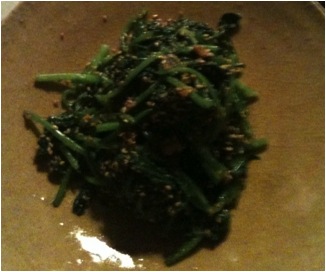
– ほうれん草のごま和え “hourenso no goma-ae“, boiled spinach in sesame sauce
– 冷や奴 “hiyayakko“, fresh tofu with seasoning (spring onion, ground ginger, bonito fish flakes and soy sauce)
– わかめご飯 ”wakame gohan“, salty wakame seaweed mixed in freshly cooked rice
– 葱のみそ汁 “negi no miso-shiru“, spring onion miso soup

today, out of these dishes, i would like to share a recipe for “hourenso no goma-ae“, boiled spinach in japanese sesame sauce. it is a nutritious, healthy, totally vegan side dish. the iron taste of spinach matches perfectly with the mild yet strong flavour of sesame, which is nicely combined with the soy sauce.

for short, let’s call it “spinach goma-ae”

*********************************

“spinach goma-ae”

1 batch of fresh spinach
3+ table spoons of ground sesame seeds (i always grind them right before i use – nice & fresh!)
1 table spoon of brown sugar
1 table spoon of soy sauce

1, in a big & deep cooking pan, bring water (to 3/4 to the top) to boil, and add the spinach. boil it until the water just turns to light green (2 minutes or so)
2. take out the spinach, rinse it in cold water until it is nice and cool
3. gently squeeze the water out of the spinach by hands
4. cut the spinach into 4 – 5cm length
5. make the sauce: mix the ingredients above (sesame, sugar and soy sauce)
6. add the spinach into the sauce and mix it thoroughly

that’s it – so easy and tasty.

*********************************

not to mention, my stomach was fully satisfied at the end of the meal. there is no place, like home.

being japanese

2 months have past since the Tohoku/Kanto earthquake on 11th of march 2011. the terrain seems to have calmed down finally (at least in Tokyo), and our life is almost back to normal. i still get a bit sensitive from time to time, whenever our furniture makes some squeaky sound or the apartment gets vibrated slightly from a truck passing by our street. when that happens i get tense for a second, but resume my daily life right after. most of the time i spend a day without thinking about the threat from the ground, which is a great relief.

given the impact of the disaster, the earthquake and the incidents occurred around it have been and are still, quite naturally, the main topics at the dinner table. for the past couple of months, i have noticed cultural or maybe personal differences in a variety of occasions. it is not about right or wrong, but just different. there are too many examples to tell, but these things can be summed up to the very basic ideas of human behaviour as follows:

– a virtue of perseverance vs. a spirit of survival
– compassion towards the problems, or discrimination against the problems
– surrender vs. confrontation
– acceptance vs. denial
– conformity vs. individualism

under the extreme circumstances of the disaster, i have witnessed these fundamental differences in people’s mindset, and realised how much influence we are prone to get depending on where you grow up, how you are brought up, and whom you grow up with.

as mentioned earlier, i believe there is no right or wrong in whichever you react. it’s just the differences in mentality and values which are built on years and years of history around the world. one thing i can say is, being a native of a mono-cultural society, we are expected, by our fellow country people, to act in certain ways to conform to what the society believes in. in such environment, sometimes it can be hard to have differences in opinion, especially when you are exposed to a multitude of ideas and are surrounded by a diversified group of people.

being among different cultures, ethics and ideologies, sometimes it gets pretty confusing in regards to what i should or want to have faith in. of course i am proud to be japanese and love our culture dearly, but on the other hand there are certain ideas that i do not agree to, but i find it hard to voice it. i am afraid of not being accepted, and am scared of being regarded as a traitor. perhaps this characteristic itself is the most japanese quality that i possess and try so hard to disguise.

i don’t know how to finish this essay, as i guess there is no relevant answer to what i am questioning. ok, i sign off here, will let it lie and observe…

japanese kimono lesson 着物教室

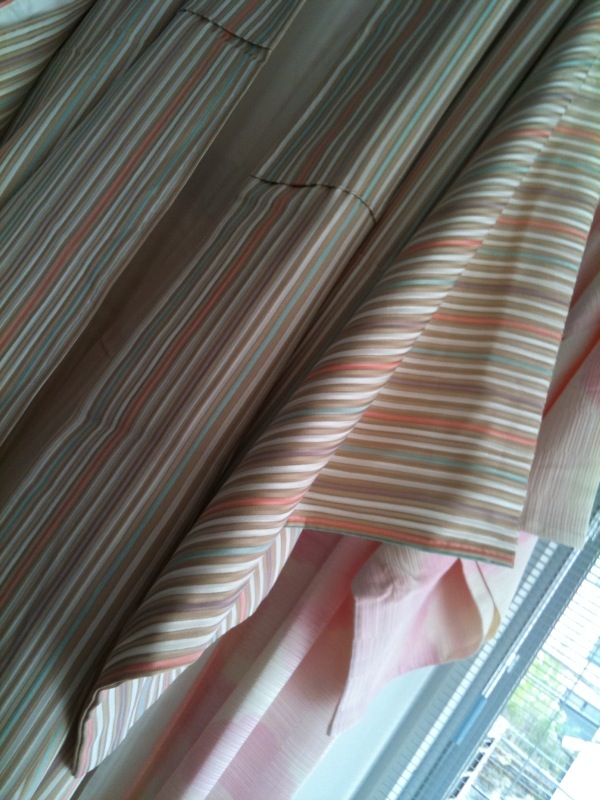
on every monday since march (right after the earthquake actually), i have been taking kimono lessons in my neighborhood in tokyo, where i learn how to wear japanese kimono on my own. embarrassingly enough, i don’t know how to put it on by myself despite my cultural background, since someone else always did it for me.

taking the lesson every week, i have realised how mentally exhausting it can be to learn something brand new, especially at this stage of my life where more than a decade has long past after graduating from the university. after each lesson, i come home being literally worn out, overwhelmed with the mixture of familiar/unfamiliar words and rules concerning the japanese tradition and history.

still, acquiring this particular skill is a delight and a great addition to my life, as if this will fill in another missing puzzle of my being. every monday at 2pm, my teacher, a short, charming and cheerful lady presumably in her 60’s, greets me at the entrance door of her home, always in different and unique types of seasonal kimono. each time i open the door with an anticipation of the colour, material, pattern and small trinkets of the kimono she beautifully wears.

during the 2-hour lesson, while i learn the practical side of kimono dressing, my mind often trips back to my childhood memory. a vision of kimono, a smooth & cold texture of silk, a smell of this particular aroma specific for keeping all the garments, a posture of an elegant bow on the floor… all of which remind me so much of the time i spent with my grandmother when she was still alive, who used to teach japanese tea ceremony in her kimono at home. she allowed me to be around when she was teaching, and tried to show me how to do it a few times. but all those attempts always ended up in failure, because i was not so interested and never appreciated the fact that i was so close to it. now that she is gone, i realise the significance of what i missed out. the sense of regret waves into my head, and my heart starts to beat a little faster than normal. but then my mind comes back to the present and the reality of another practice goes on.

at the end of the lesson today, the teacher told me that it was her mission to encourage the young generation of japanese people to wear kimono, in order to preserve and pass on our culture to the future. being married to a non-japanese person, it is quite likely that i may move out of japan with him one day in the future. but even when this happens, i want to take them all with me to wherever we go – the subdued, yet unyielding values this country has taught me.

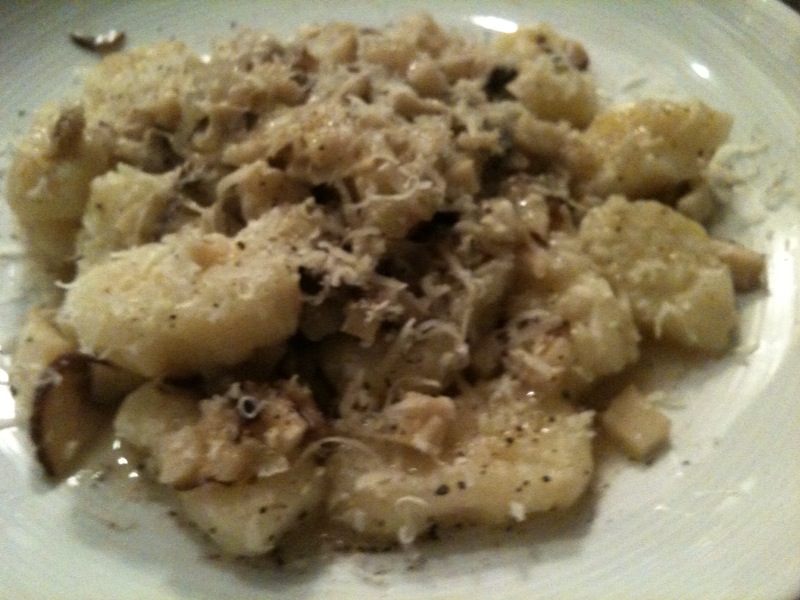
my first gnocchi (di patate)

having a dutch husband, coming up with potato dishes becomes always a challenge. he was raised on potatoes and absolutely love them. the problem is, since japanese don’t eat as much potatoes as westerners, i can only think of a few dishes to cook.

once i cooked 肉じゃが (nikujaga), japanese stewed potatoes cooked with onions, carrots, pork slices, seasoned with soy sauce, sake and mirin. in the japanese kitchen, the dish is regarded as おかず (okazu), a side dish. i served it along a bowl of white rice, miso soup and some other side dishes like pickles or something, and my husband got a bit furious and said to me, “why are you serving rice with potatoes?!? i don’t need any rice, i can’t have two different staples at the same time!….” this was totally a brand new experience for me. in fact, i’d never had potato dishes without rice. here again, i stumble upon yet another cultural difference.

anyway, i wanted to explain how important potatoes can be for a dutchman. to my dismay, i always end up wasting potatoes (they tend to start sprouting on me), and this time, i didn’t want to make it happen – hence the gnocchi.

it was so easy actually and came out nicely. final result? a smiling husband.

gnocchi di patate (potato gnocchi) for 2

ingredients:
200+g of potatoes (2 medium sized potatoes)
50g of hard flour
a pinch of salt

directions:
1. first you boil the potatoes (approx. for 20 – 25 min).
2. once boiled, peel the skin when the potatoes are still hot
3. mush them!
4. put the flour and the salt.
5. knead the dough
6. make 2 tubes of 2 – 3cm diameter
7. cut into 2cm pieces and make small balls
8. push each ball with a fork slightly and leave its mark

that’s it! from 5 – 8, it’s easier to do it with extra flour.

boil it in boiled water, and when the gnocchi start to float over the surface, it’s ready. drain the water and mix it with the sauce.

mushroom sauce

ingredients:
3 shiitake mushrooms, chopped
3 eringi mushrooms, chopped
1/2 a clove of garlic, cut into 6 pieces
1/2 onion, chopped
2 tbsp of butter
2 tbsp of extra virgin olive oil
a pinch of rosemary
a cup of water
1/4 cup of white wine
a half cube of chicken stock
salt & pepper to taste
some parmiggiano leggiano

directions:
1. melt butter in a frying pan and add olive oil
2. gently fry garlic, onion and rosemary until the onion is transparent
3. add the mushrooms, stir-fry a little bit and sprinkle salt & pepper. stir-fry a bit more
4. add the wine until it gets absorbed
5. add the water and chicken stock and cook for another 3 min. or so.
6. add salt & pepper to taste

when serving, sprinkle over the grated parmiggiano leggiano & extra pepper.

buonappetito!