Category Archives: japanese 日本食

fried rice with salmon 鮭チャーハン

in the japanese kitchen, there are many dishes which are influenced by cuisines from other countries. curry & rice, one of the earlier japanese dishes i posted for example, is influenced by (obviously) the indian.

last night, i made 鮭チャーハン “sake cha-han“, fried rice with salmon. in japan, we eat many kinds of fried rice dishes, which are variations from the chinese kitchen. with our impeccable talent to recreate and enhance, a series of modern japanese dishes with foreign origins were born, just like this salmon cha-han:
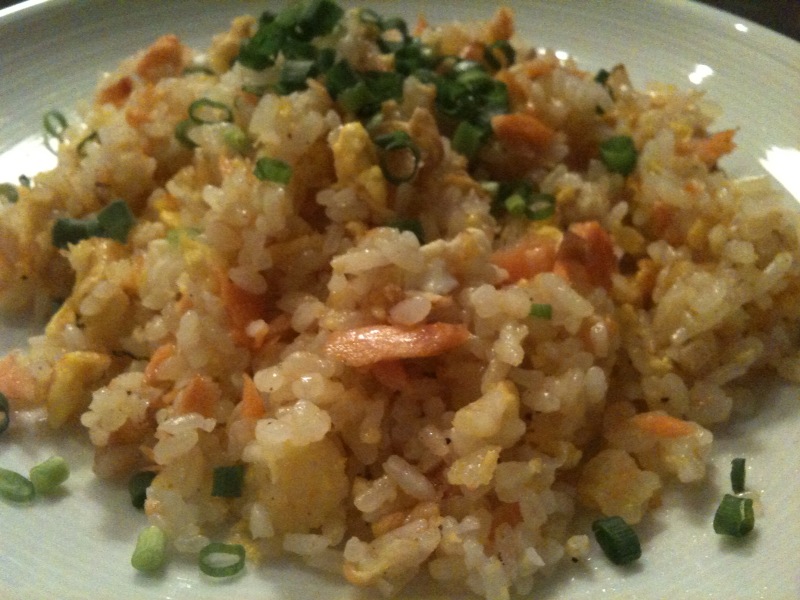
fried rice with salmon

– 1 fillet of salmon (lightly salted, grilled and broken into rough pieces before frying)
– 2 eggs, beaten
– 2+ cups of cooked rice
– 12cm of japanese leek, chopped
– 4 table spoons of salad oil
– 1+ table spoon of japanese sake
– salt & pepper to taste
– if available, a pinch of konbu (kelp) dashi powder, but can do without
– sprinkle of chopped spring onion or chives

1. in a frying pan or a wak, pour in the oil and heat it up well (really well), and add the eggs
2. quickly scramble the eggs with a spatula and when they are still half cooked, add the rice and quickly mix it with the eggs
3. once mixed, add the leek and the salmon and further stir-fry quickly
4. from the rim of the pan, add the sake (the alcohol will remove the fishy smell of the salmon) and the konbu powder (if available) and further stir-fry quickly
5. at the end, add salt & pepper to taste and quickly stir-fry
6. when serving, sprinkle the spring onion/chives over the fried rice.

the entire steps from 1 – 5 only takes about 5 minutes or so (or even less). do every step very quickly, in order to avoid the rice from getting soggy and sticky.

this time, i served the fried rice with vegetable soup (in chicken broth) and cucumber salad.
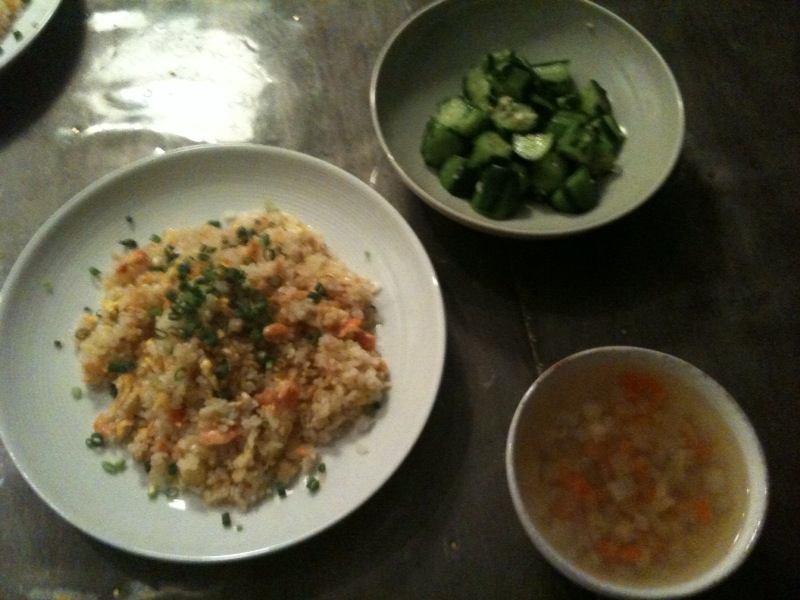
召し上がれ meshiagare (bon appetite)!

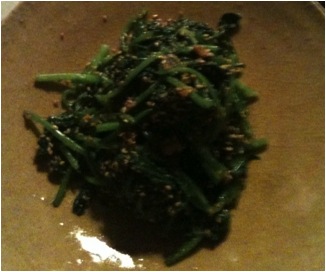
my soul food 故郷の味 (& recipe for spinach goma-ae)

our dinner last night – a few, very typical, japanese dishes:

– アジの干物 “aji no himono“, grilled horse mackerel (seasoned & dried)
– かぼちゃと鶏挽肉の煮物 “kabocha to tori-hikiniku no nimono“, simmered pumpkin and minsed chicken
– ほうれん草のごま和え “hourenso no goma-ae“, boiled spinach in sesame sauce
– 冷や奴 “hiyayakko“, fresh tofu with seasoning (spring onion, ground ginger, bonito fish flakes and soy sauce)
– わかめご飯 ”wakame gohan“, salty wakame seaweed mixed in freshly cooked rice
– 葱のみそ汁 “negi no miso-shiru“, spring onion miso soup

today, out of these dishes, i would like to share a recipe for “hourenso no goma-ae“, boiled spinach in japanese sesame sauce. it is a nutritious, healthy, totally vegan side dish. the iron taste of spinach matches perfectly with the mild yet strong flavour of sesame, which is nicely combined with the soy sauce.

for short, let’s call it “spinach goma-ae”

*********************************

“spinach goma-ae”

1 batch of fresh spinach
3+ table spoons of ground sesame seeds (i always grind them right before i use – nice & fresh!)
1 table spoon of brown sugar
1 table spoon of soy sauce

1, in a big & deep cooking pan, bring water (to 3/4 to the top) to boil, and add the spinach. boil it until the water just turns to light green (2 minutes or so)
2. take out the spinach, rinse it in cold water until it is nice and cool
3. gently squeeze the water out of the spinach by hands
4. cut the spinach into 4 – 5cm length
5. make the sauce: mix the ingredients above (sesame, sugar and soy sauce)
6. add the spinach into the sauce and mix it thoroughly

that’s it – so easy and tasty.

*********************************

not to mention, my stomach was fully satisfied at the end of the meal. there is no place, like home.

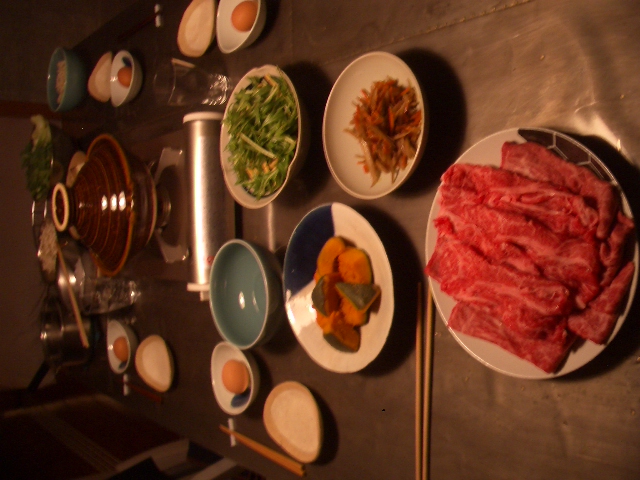
dinner with friends – H & E (& the recipe for the すき焼き “sukiyaki” broth)

we had 2 guests over at our place on one sunday evening. i didn’t want to put too much effort in preparation for the dinner, as i had a big sunday brunch with my girlfriends earlier that day.

for such occasion, すき焼き (“sukiyaki”) can be a perfect solution. sukiyaki is like a fondu, but we use soy sauce base broth instead of cheese. in theory, you let your guests cook their own food, but it is fun and very interactive.

for preparation, all you have to do is to make sukiyaki broth (割り下), cut the vegetables & other ingredients and buy good beef slices. in japan, sukiyaki is regarded as a luxurious meal and is suitable for treating your guests.

cooking our own food in the same pot seems to create a certain level of intimacy. it must have something to do with a team work spirit – someone puts the meat in, another puts the vegetables, and another makes sure that the food is not overcooked… and everyone has to keep a good balance of how much you or other people eat from the pot.

this time, the guests were my husband’s friends from the same graduate school. all of them studied architecture (and both guests have a PhD) and have a lot (i mean it, a whole lot) to say about it. the conversation continued on and on as they cooked and ate from the pot, more eloquent, more philosophical, more technical and more challenging…

here is the recipe for the sukiyaki broth for your intimate dinner (for 4 people):

soy sauce – 200cc
mirin sauce – 200cc
sugar – 70 – 80g (adjust as you like)
water – 120cc
sake – 3 table spoons
昆布(dried kelp) – 1 slice (approx. 3cmx5cm)

pour all the liquids in a deep pot, bring the mix to boil, and turn off the heat. put the kelp in and let it cool down.

use this broth when cooking the beef slices & other ingredients (japanese leek, japanese shungiku leaves (春菊), shiitake mushrooms, enoki mushrooms, tofu, etc.

use fresh raw eggs as dipping sauce (very yummy!).

お汁粉 “oshiruko”, sweet red bean soup

in japan, we eat a lot of sweets made of “あずき”, red beans.

in my opinion, お汁粉 (“oshiruko”), sweet red bean soup, is one of the most well-known, easy to prepare, comfort desserts for us japanese. also it is healthy and tasty.

during the past new year holiday, i had a chance to learn how to prepare it from my mom.

ingredients:

250g red beans
200 – 240g sugar (depending on the amount of soup)
a lot of water
a pinch of salt

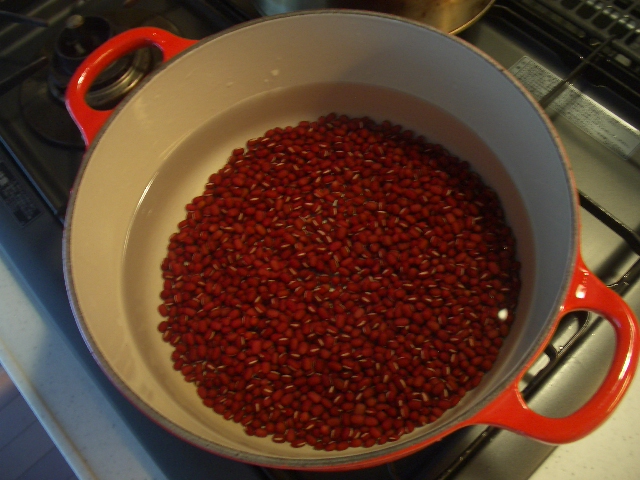
first, quickly rinse the beans in cold water.

put the beans in a deep pot, pour water in (3 times more than the beans) and bring it to boil.

once the water is boiled, drain the water and put the beans back into the pot. again pour water in (this time 3 – 4 times more than the beans) and bring it to boil again.

once the water is boiled, lower the heat and keep boiling the beans until the beans are soft (this takes about 30 – 40 minutes). if the amount of water reduces to the surface of the beans, add more water in so that the beans are always covered in water.


after 30 minutes or so, it will look like this (the colour of the soup comes out of the beans)

tip – while the beans are cooked, make sure to skim off the white foam coming up on the surface. this white foam is the cause of bitterness, and we don’t want it for the oshiruko.

once the beans become soft (until their core becomes soft), add the sugar in, stir and melt the sugar, and then put a pinch of salt to enhance the sweetness. adjust the amount of sugar to your preference.

tip 2 – make sure to put the sugar in only after the beans are soft – after adding the sugar, the texture of the beans stays the same no matter how long you cook the beans.

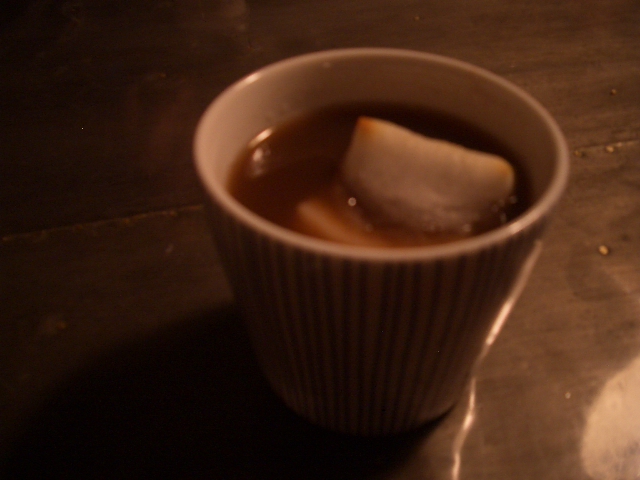
serve it hot (or cold if you like it), with a piece of toasted お餅 (“omochi”), rice cake.

special thanks to my mom for sharing this recipe. wherever i will move in the future, i will make sure to make this dessert in a cold winter day, to remind myself of my origin, my home, and my childhood.

七草がゆ (7 herb porridge)

in japan, we celebrate new years day just like christmas in the west. families get together, eat the new year’s feast called “おせち (osechi)”, preserved type of food such as beans, egg cakes, fish cakes, vegetable pickles, etc. which are prepared a few days in advance and nicely decorated in layered boxes. we also eat this soup called “お雑煮 (ozouni)”, which in the area where i’m from is usually bonito fish based soup with chicken, raddish and carrots, always served with “お餅 (omochi)”, sticky rice cake.

this year we were in japan over the new year’s period, so we had my parents over at our place and had the new year’s feast with them. to my dismay however, due to all the preparation & excitement for the new year’s day, i totally forgot to take photos of this great feast – dah!!!

so here i present what we eat 7 days after the new year’s day (so 7th of january), which is called “七草がゆ (rice porridge with 7 different kinds of herbs)”.

traditionally we eat this porridge to let your stomach rest after the continuous big feasts over the new year’s holiday. it’s completely vegetarian (vegan actually) with natural ingredients and the taste so soft for your stomach (just used salt to taste). it is good for digestion as well.

after a bowl, the taste gets a bit blunt, so we can put some topping over it, and this time i had raddish pickles with yuzu citrus, bonito fish flakes with soy sauce, and some mitsuba (trefoil) leaves.

ingredients (for 2 – 3 people)

1 cup of rice
7 japanese herbs – chopped (3/4 cup or so)
(which can be replaced with raddish, raddish leaves, turnip, turnip leaves, italian parsley, etc.)
4+ cups of water
salt to taste

in a big deep pot (preferably earthen pot), pour the rice and rinse it a few times with cold water. after draining, put 4 cups of water in the pot, put the lid on, and bring it to boil in medium heat. when the water starts to boil, lower the heat to the tiny heat and let it cook for 30 minutes or so until the water is almost absorbed into the rice. remember to gently stir the rice from time to time so that the rice would not stick into the bottom of the pot.

while the rice is being cooked, boil the water in another pot, sprinkle a pinch of salt and quickly boil the chopped herbs (a minute is enough).

add the chopped herb to the rice when the rice is almost ready. cook them jointly for 5 minutes or so, add 2 – 3 pinches of salt to taste.

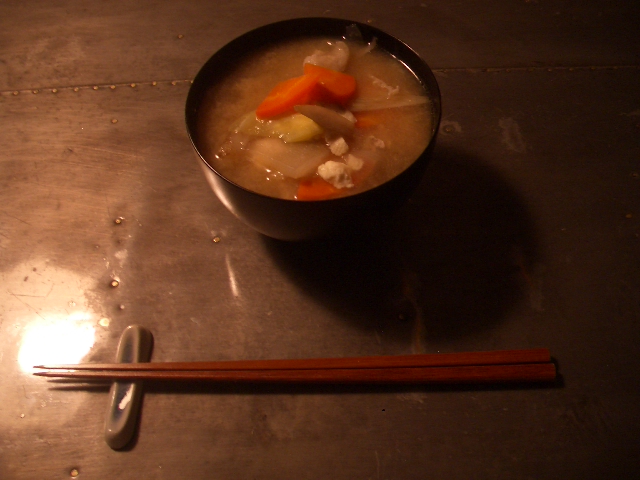
warmth of home – 豚汁 “tonjiru”

i didn’t have a good day at work. nothing serious, but it still made me down and took my energy away. the cool air outside with the smell of crisp brownish yellow leaves somehow reminded me of home, my parents home in the outskirts of tokyo where you can still find small vegetable fields beside a train track. all of a sudden i missed it so much. how comforting it was, despite occasional quarrels, disagreements and interferences, i was always protected, accepted and cared for.

i craved for something my mum had always cooked for us when we were little, my sister and i. once in a while from autumn to winter, she cooked a gigantic pot of 豚汁 (“tonjiru”, miso soup with pork), with a lot of vegetables and some pork meat. my mum grew up in the country side, in a mountain village, with 5 other siblings. the soup was perfect for a big family like that – it is very nutritious and easy to prepare, and most of all it tastes really good, containing the juicy essences from the vegetables inside. it’s basically an upgraded version of miso (soybean paste) soup, with lots and lots of root vegetables, tofu and thinly sliced pork pieces.

i actually never learned how to make it from my mum, nor have i got a recipe from her. after all it’s a very simple dish and how to make it is quite self-explanatory if you know how to make other miso soup, so i never bothered to ask her before. the funny thing is though, that the taste comes out to be exactly like hers.

豚汁 “tonjiru” (for 2)

1/6 of japanese radish (daikon) – “icho-giri”, triangle slices
1/3 of carrot – “icho-giri”, triangle slices
1/2 of gobo (burdock root) – “sasagaki”, thinly shaven
1 “naganegi” (leek), roughly sliced diagonally
1/2 of momen tofu (cotton tofu), broken into a mouthful size by hand
100g pork slices, cut into small pieces
1/2 tea spoon of dashi powder
1 liter of water
miso paste to taste (3 table spoons)

in a deep pot, put the water, the root vegetables and bring the water to boil. put naganegi and tofu, pork slices and dashi powder into the pot, again bring to boil. lower the heat, gently remove the layer of residue floating on the surface with a ladle, and simmer for 20 minutes or so. once the root vegetables become soft, put the miso paste in and have it melt by stirring, and simmer for another 5 – 10 minutes. adjust the amount of miso paste to your preference.

a bowl of tonjiru gave me an amazing level of security. it’s just miso soup but i felt at ease. i felt the warmth of home, deep inside my stomach.

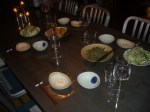
dinner with friends – M & G

one saturday evening, we had a special couple over for dinner at our home. they are the reason why i met the love of my life, and i hope he feels the same way, and both of us are never be able to thank them enough.

it feels so special that we are all in tokyo, at this phase of our lives, all with quite different background, let alone our nationalities, but something always puts us together – and at one point i realised that it was food. the 4 of us have an incredible appreciation towards food. the couple are from portugal, and i remember their telling us once that whenever they go on a holiday back home, they always come back with a suitcase full of food – salted cod fish, cheese, hams, port… i used to do exactly the same when i lived abroad. coming back to tokyo with 2 – 3 bottles of good olive oil, or leaving tokyo with a few packs of udon noodles and natto paste…

cooking my comfort food for them was a tremendous pleasure for me – i reckon that it is quite rare for them to be invited to a japanese house (well, mixed, but close enough), and thought it might be a good idea to go totally local. the dishes i cooked for this special evening were very ordinary japanese home cooked meals.

as starter dishes, i made

冷や奴 (hiyayakko, “cold tofu”) – fresh tofu with sliced veggies such as leak, cucumber, myoga, etc. with soy sauce
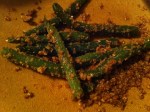
いんげんのごま和え (ingen no goma-ae, “green beans in sesame paste”) – boiled green beans, ground sesame, sugar & soy sauce
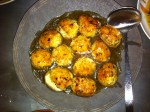
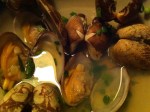
あさりの酒蒸し (asari no saka mushi, “steamed crams in sake”) – crams, salt & sake

the main course was しいたけの肉詰め甘酢あんかけ (shiitake no niku zume amazu an-kake, “shiitake mushroom and meat stuffings with sweet sour sauce”). this time i used minced chicken with chopped ginger, leek and stalk of the mushrooms. the sauce is made with vinegar, soysauce, “mirin” sauce and katakuri powder (starch) to give it a thickness.

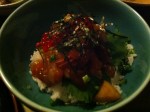
and in any japanese course menu, there is always a 〆の一品 (shime no hitoshina “a dish to top it off”) with some carbohydrates. for this occasion i made 刺身タルタル丼 (sashimi tartar don), with ikura (salmon egg roe which look like orange pearls), to make the dish more luxurious than usual.

for a dessert, we had M’s famous chocolate mousse – she does the best chocolate mousse in the whole world – that they brought especially for this occasion (my husband dies for this chocolate mousse).

no 3-star restaurant can beat a home cooked dinner with friends & family like this one tonight, and our thanks go to M & G.

close-up photos provided by M (proudly taken on her new iPhone G4 😉 )

カレーライス curry & rice

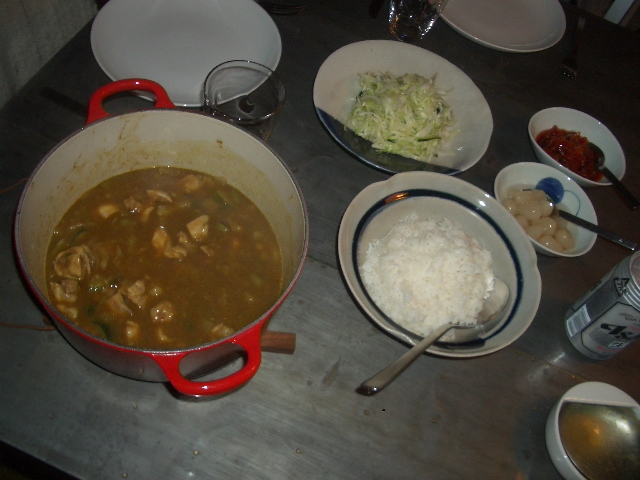
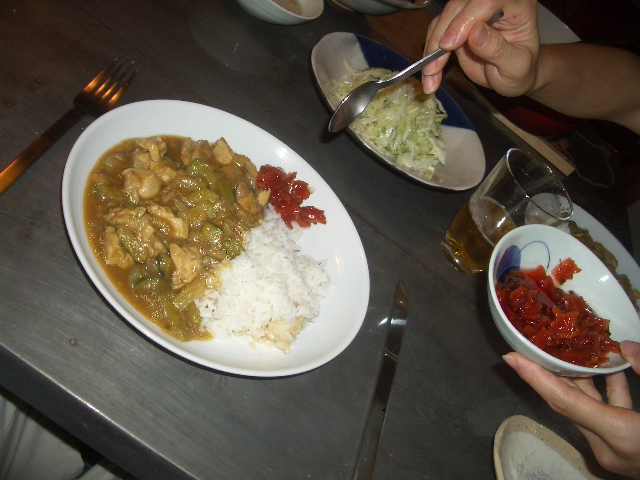
this is japanese curry & rice. in fact, the majority of japanese people love this dish. it is one of the dishes in japan, in my opinion, that you would think about cooking for your boyfriend for the first time.

we don’t make curry paste from scratch actually, but use curry blocks instead which melts into the broth. you can get the blocks in any grocery store, and there are at least 10 different brands, each of them offers “sweet”, “medium spicy” and “spicy” tastes, lying next to each other on a big shelf. i know it’s a bit like cheating, but that’s how our mums & grandmas have traditionally made the dish all along (i don’t think it goes back to my great-grandmother’s generation though). it’s so handy that people make curry all the time, which is probably very different from what non-japanese people would imagine what we would make at home. we vary what to put in the broth, for example this time i used chicken, onion, zucchini and celery.

the red stuff i am putting on the dish is called 福神漬け, fukujin-zuke pickles. the taste is sweet & sour, goes very well with slightly spicy curry sauce. it is always, always served with the japanese style curry & rice: the-curry-wouldn’t-be-the-same-without-it, kind of thing. this one too, we don’t really make at home, but buy ready-made one at a grocery shop. the colour is dreadful, but picturesque (no?).

Oyakodon (chicken & egg on rice)

Have you ever heard of a Japanese dish called Oyakodon 親子丼?

It is a quick and easy dish to prepare. One Monday evening, I left work quite late and was hungry, but wanted to eat at home to relax. On my way home I thought about some leftover noodle soup (mixture of bonito broth, soy sauce, sake & mirin) in my fridge as well as frozen chicken and rice in the freezer. I always have eggs in the fridge, so decided to spend 15 minutes in front of the kitchen counter to fix up Oyakodon.

All you need for two servings are:

– 200g chicken thigh (chopped into bite size pieces. better to have some skin for extra flavour)
– Half an onion (thinly sliced)
– 100ml fish broth (freshly made broth from bonito flakes, or you can use the broth powder and melt it into boiled water)
– Soy sauce (approx. 2 tbsp)
Sake (approx. 1 tbsp)
Mirin (approx. 3 tbsp) + sprinkle of sugar if preferred
– 3 eggs
– Rice and some Mitsuba leaves (trefoil) or Nori seaweed

Directions:

1) In a frying pan, fry the onion slices (with some cooking oil if you have) until it starts sweating and translucent
2) Add the chicken and cook for a few minutes until lightly brown
3) Add the sake, stir, and then the broth, soy sauce and mirin into the pan (the liquid mixture should just cover the surface of all the ingredients in the pan)
4) Bring it to boil, add sugar, cook for another minute or so
5) Taste the sauce – if it is too salty, add a bit more sake/mirin/sugar. If it’s too blunt, add a little more soy sauce and a bit more sugar. Adjust according to the consistency of your sauce
6) In a separate bowl, beat the eggs, and sprinkle the egg mixture onto the boiling ingredients in the pan (make some circles)
7) Put the lid on the pan, turn the flame off, and let it rest for a few minutes
8) In two medium serving bowls put freshly cooked (or freshly defrosted in my case) rice, gently place the oyakodon mixture along with the sauce
9) Sprinkle the chopped mitsuba leaves or nori seaweed on top of the mixture to add an extra colour and a kick to the taste

All the process above takes only 15 minutes or so.

The name “oyakodon(親子丼)” comes from oya (meaning parent, in this case “chicken”) and ko (child, and here referring “egg”), and don (bowl)…. oya-ko-don. Chicken & egg on a bowl of rice.

There you go!

ネギトロ丼 negi toro don

many people abroad seem to think that we japanese eat sushi at home. the kind of sushi with a thin slice of fish flesh and a small rice ball underneath. in fact though, we don’t really eat those at home. it requires a high level of skill to which we usually depend on professionals.

an alternative solution for sushi-esque dish for home is this type of 丼 “don” dish with raw fish on top. “don” dish is usually a ball of rice with main course & side dish altogether on top as topping. topping can be anything, doesn’t necessarily have to be raw fish only. it can be tenpura, chicken & egg, beef stew, etc. it is a very practical & efficient dish.

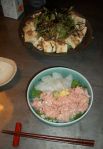
anyway, today’s topping is negi-toro, fatty tuna tartar mixed with leek (negi) chops, along with a few slices of flounder sashimi, decorated on japanese “shiso” basil leaves. as its sauce, i used soy sauce, mixed with grated wasabi & a tiny bit of grated ginger.

for my portion of negi-toro don, one more ingredient was added – my favorite food called “natto”, fermented soy beans, which makes a perfect resonance with other ingredients (so i believe). after living more than 10 years in Japan, my Dutch husband still refuses to eat it, claiming it’s because of the smell. but to be honest i think the smell of cheese is much stronger and unbearable.

with tofu salad as an extra dish.